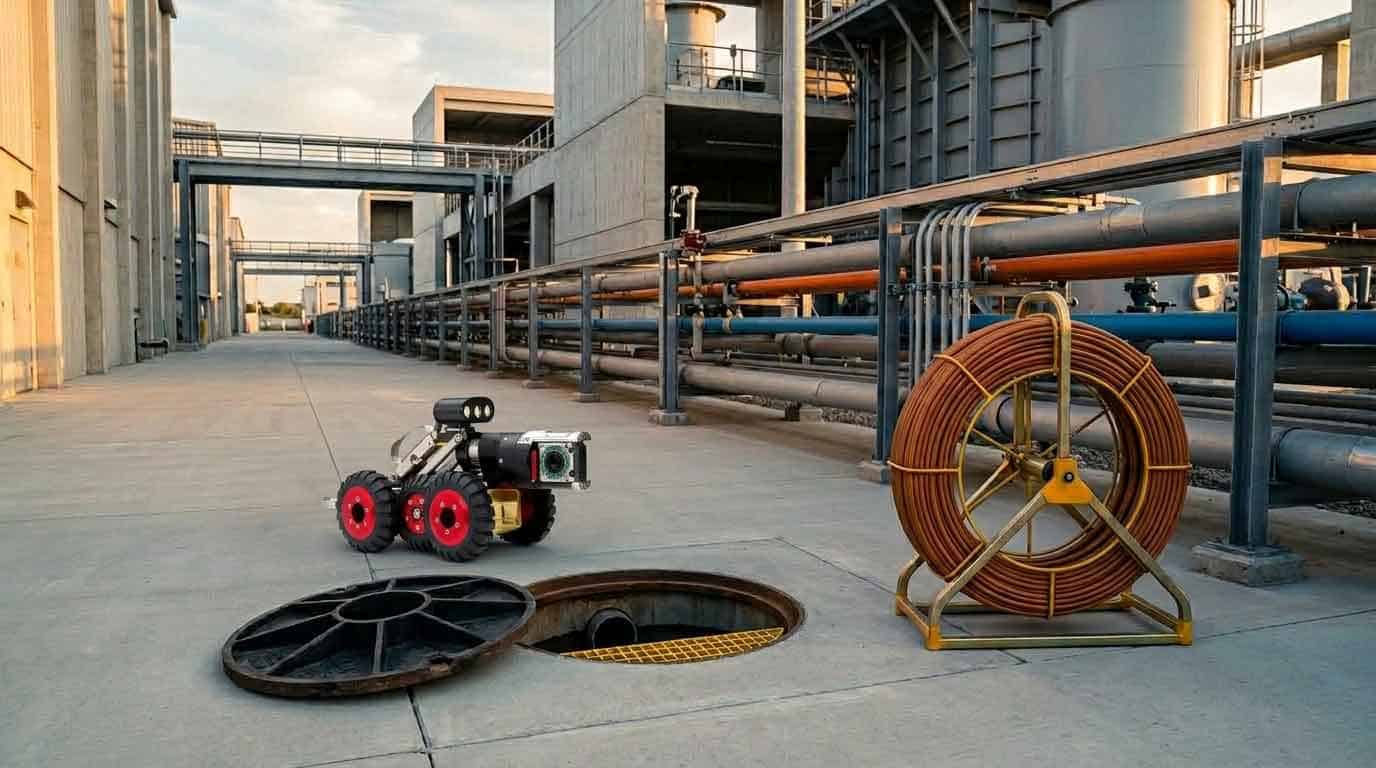
Why Pipe Video Inspection Before Rehabilitation Belongs in the Quote
A quote for rehabilitating a plant line arrives, and it was priced from the as-built drawing and a walk of the site. That is a common way for industrial rehabilitation work to get priced. What the quote does not say is whether anyone has looked inside the pipe, and pipe video inspection before rehabilitation is the step that separates a number from a scope.
The distinction is worth a paragraph.
A quote written from the drawing is a quote for the line the plant thinks it has. A quote written after a camera has been through it is a quote for the line that is actually there. At manufacturing plants and mills, where utility and process lines have been added to, tapped, and repaired for decades, the gap between those two lines can be wide.
Hill Services offers to put the camera through the line before the work is priced, and the reason is not the line item. A scope for trenchless pipe rehabilitation built on a bad assumption does not get cheaper when the assumption is discovered. It gets discovered at the worst possible time.
What the Camera Finds That the Drawing Does Not
An as-built drawing records what someone intended to install, filtered through whoever updated the file last. A camera run records what is in the ground today. The two disagree in a handful of predictable ways.
- Actual condition against assumed condition. Scale, pitting, fouling, and wall loss that a drawing has no way to show.
- Joints and connections that are not where the drawing says they are, or that the drawing does not show at all.
- Diameter changes partway down the run, from a repair or a reducer nobody documented.
- Offsets, sags, and intrusions, including taps and laterals cut in after the drawing was filed.
- Earlier repairs. A point repair, a clamp, or a short section of different material in the middle of a line that is supposed to be one thing end to end.
- Whether the line is the material of record in the first place.
Each of those changes how the line is cleaned, whether it can be lined at all, which liner fits, and how long the crew is on site. The report Hill Services delivers after a pipe video inspection records diameter, length, location, and condition for the run, with a reference map marking where the problems are. That document is what the quote is written from.
The camera settles one more thing, and it decides whether the project is trenchless at all: access. Where the crew can get into the line, and whether an existing manhole or cleanout will serve. On a Gulf Coast job that answer is often the difference between two small pits and a trench through a plant road, which is why Hill’s Houston operation would rather see the inside of the pipe before a rehabilitation is priced than after.
How Often the As-Built Is Wrong
Often enough that it is planned for.
That is the honest answer, and it is more useful than a percentage would be. Nobody in the field keeps a tally. What the field does know is that a line a few decades old, inside a facility that has changed hands or changed processes, is more likely to surprise the crew than not. Older plants, more owners, more turnarounds, more surprises.
So the inspection is not a hedge against an unlikely event. It is a routine step against a likely one.
A Day Up Front Against a Surprise Mid-Project
The economics are what the engineer holding that quote should weigh, and they are lopsided.
An inspection happens before anything is committed. If the line turns out to be something other than expected, the scope changes on paper. The liner gets re-specified, the access plan gets redrawn, the schedule moves, and nobody has mobilized yet.
A surprise found mid-project happens after everything is committed. Crews are on site. Access is open. The line is isolated and out of service. The plant has scheduled production, or a turnaround window, around a duration that is now wrong. The extra work is rarely the expensive part. The schedule is. A reducer nobody knew about, discovered with the liner on the reel, adds days to the job and pushes the plant’s restart with it.
Point is, the inspection is not the cost of finding problems. It is the cost of finding them while they are still cheap to find. A quote written from an inspection tends to hold. A quote written from a drawing tends to grow a change order, and the engineer who accepted it is the one explaining that upstairs.
Two Jobs Where the Camera Went In Before the Liner
Both project stories Hill Services has published in this series turned on the same step.
At a petrochemical facility on the Houston Ship Channel, roughly 16,000 feet of discharge line was out of service and the plant was trucking treated wastewater daily. The crew cleaned the line, then ran a camera through it end to end to prove the cleaning had worked before a single foot of liner was committed. On a run that long, a problem found after the liner is in is not a rework item. It is a second project.
At a chemical plant, a water line that had been patched more than once ran beneath cooling towers, buildings, and a road. The crew ran a camera through the host pipe to document its condition before anything else, then ran a second pass after cleaning to confirm the line was ready for a liner. The segment was back in service in about a week, from two small access points.
In both cases the liner went in only after the camera had shown what it was going into.
Common Questions About Inspection Before a Quote
What does a pipe video inspection show?
The inside of the line, end to end: pipe material, joints and connections, diameter changes, offsets and sags, intrusions, earlier repairs, and the condition of the wall. The output is a recording, a written report, and a map locating each problem along the run.
How long does an inspection take?
It depends on the length of the run, the number of access points, and how much cleaning the line needs before a camera can travel it. A short run with good access can be done in a day. Either way it is measured in days, not weeks, and it happens before mobilization.
Can a line be inspected while it is in service?
Sometimes. Gravity lines and low-flow drains can often be inspected without a shutdown. Pressure and process lines usually need to be isolated and drained first, which is a reason to fold the inspection into a planned outage.
Reading the Line Before Pricing the Work
The surprise mid-project is a solvable problem. Put the camera through the line before the quote is written, price what the camera found, and let the plant approve a scope built on the actual pipe. The inspection costs a day and a line item. The alternative costs a schedule.
How Hill Services Approaches This
Hill Services can put a camera through the line before the work is priced, so the scope reflects the condition of the line rather than an assumption about it, and the report stays with the plant as a record of what is in the ground. To discuss a line that needs a look before the work is priced, request an estimate or call Hill Services at (901) 388-7500.