Repairing a Pipe Under a Building Without Excavation Starts With Access
A 10-inch water line at a chemical manufacturing plant ran beneath the cooling towers, several buildings, and the main road connecting them. It had already been patched more than once. Each patch held for a while, then didn’t.
The first question a maintenance director asks is usually how to fix the line. That was not the real question here. The real question was how to repair a pipe under a building without excavation, when digging it up would mean taking apart the working part of the plant to reach the line that keeps it running.
A line patched twice is not a line with one bad spot. It is a line deteriorating along its length, and the next leak shows up somewhere the last patch didn’t reach. None of this is unusual. The average water pipe in the United States now carries a life expectancy of about 78 years, and the country logs roughly 240,000 water main breaks a year at an estimated $2.6 billion in repair costs. A line that keeps failing is a familiar starting point, not a rare one.
Opening roughly 1,400 feet of trench under cooling towers, occupied buildings, and a main road was never a realistic option here. Hill Services scopes chemical plant pipe lining work around exactly this kind of constraint: assume the asset cannot be reached the conventional way, then plan around that instead of against it.
Trenchless pipe rehabilitation is built for this situation specifically. It replaces a pipe from the inside, through a small number of access points, instead of removing the ground above it.
Two Pits, Not One Long Trench
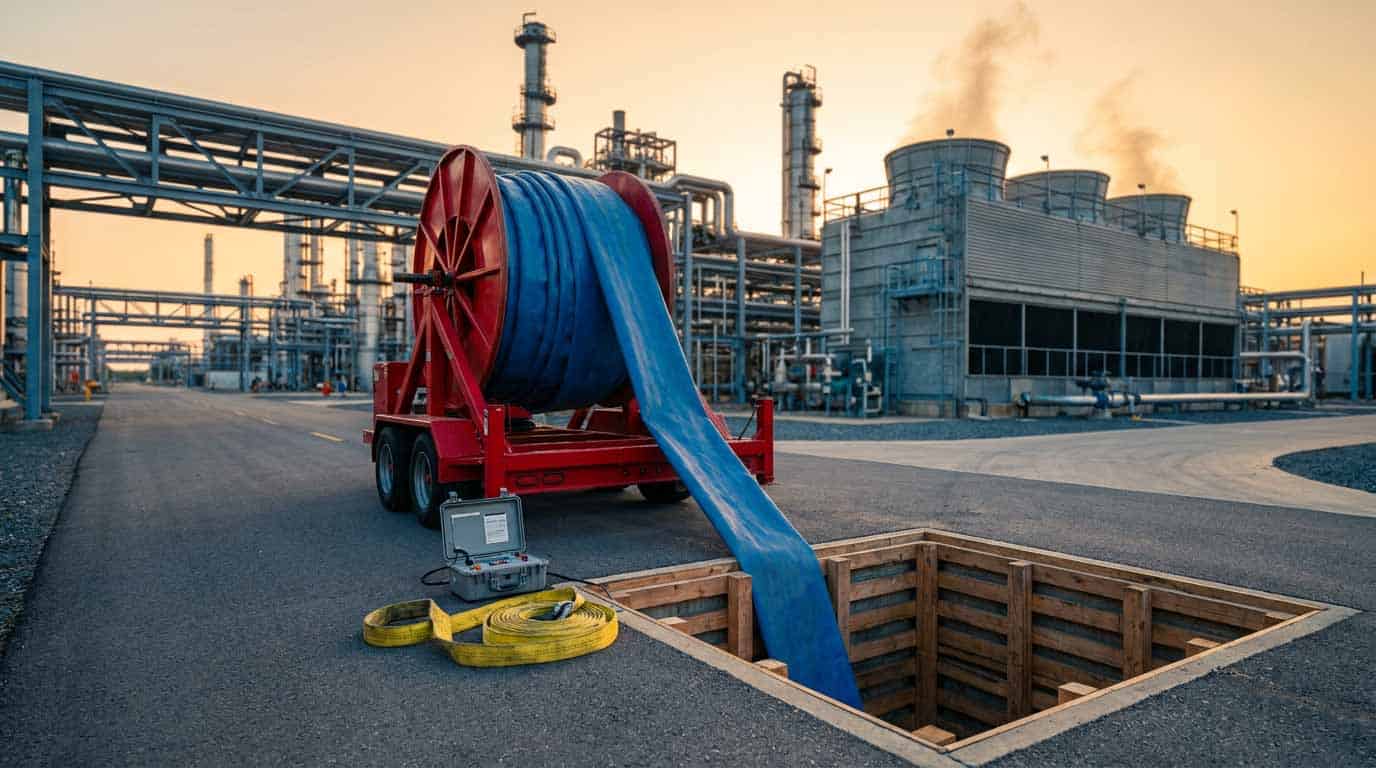
Trenchless pressure-pipe rehabilitation does not open the ground along the pipe’s route. It needs two small excavation pits per rehabilitated section: one where the liner goes in, one where it comes out. Everything between those two points, cooling towers, buildings, roadway, stays exactly as it was. Where the line branches, the crew adds one intermediate pit at the branch point and nowhere else, which kept surface disruption to almost nothing under a working plant. The same approach holds across the industrial service areas Hill Services covers nationally, on sites where an open trench was never going to be approved.
Before any liner goes in, the host pipe gets cleaned, and the cleaning gets checked rather than assumed. A pipe video inspection confirms the inside of the line is actually ready. Skipping that step is how a liner ends up installed over debris nobody caught.
Eight Steps From Access Pit to Back in Service
Rehabilitating a line like this one from the inside runs in a fixed sequence, not one operation called “reline and go”:
- Cut the two access points, plus any intermediate pit a branch requires.
- Take the segment out of service and isolate it from the rest of the system.
- Run a camera through the host pipe to document the existing condition.
- Clean the pipe wall with spring-steel scrapers and rubber discs pulled through on a cable winch.
- Confirm the cleaning with a second, high-resolution camera pass on a long-range crawler vehicle.
- Pull the new liner into place through the length of the host pipe.
- Mount connectors at each end to tie the liner into the plant’s piping.
- Pressure test the finished section, then reinstate fittings and return the line to service.
Each step gets inspected before the next one starts. On this job, the full sequence, hydro flushing the line, running CCTV to confirm the pipe was ready, installing the liner, and returning the segment to service, ran about a week.
Not Every Liner Belongs in a Pressure Application
Two rehabilitation methods get mentioned in the same breath often enough that they sound interchangeable, and they are not. Cured-in-place pipe, or CIPP, cures a resin-saturated liner in place inside the host pipe and is built mainly for gravity and lower-pressure lines. A factory-made flexible liner, the category Primus Line belongs to, is manufactured off-site and pulled into the host pipe, then pressurized to expand against it and carry the line’s full operating pressure. Specifying the gravity method for a pressure application, or the reverse, is a mistake that tends to surface well after the crew has left the site.
For years, liners built for pressure service had no standard written specifically for them, so a buyer evaluating one worked mostly from a manufacturer’s word for it. That changed in 2025, when ASTM published F3708, a standard covering aramid-fiber-reinforced flexible pipe used in loose-fit, non-interactive pressure pipeline rehabilitation. It is the first standard to define this liner category on its own terms, rather than folding it into CIPP or sliplining specifications. Tim Back of Back Municipal Consulting put it plainly when the standard was released: “With ASTM F3708 in place, there’s no ambiguity. This is a fully recognized trenchless pressure pipe rehab solution.”
Liners built to that category run three layers: a polyethylene or thermoplastic polyurethane inner layer, an aramid-fiber fabric reinforcement layer that carries the operating pressure, and a polyethylene or thermoplastic polyurethane outer layer for abrasion resistance. Rated service life runs a minimum of 50 years, verified under DIN 16887 and ISO 9080 long-term testing. The liner also holds a meaningful share of its nominal operating pressure after routing through multiple 90-degree bends, which matters on a run threading beneath buildings and a road instead of running straight. Systems in this category are certified for both drinking water and gas service, not industrial process lines alone.
Frequently Asked Questions
Can a Line Be Repaired While the Plant Keeps Running?
Yes, as long as the specific segment being lined can be isolated and taken out of service for the work. The rest of the plant, and the ground above the line, keeps operating normally. On this job, the affected segment was isolated for about a week while the cooling towers, buildings, and road above it stayed in use.
How Much Access Does a Pressure-Liner Installation Actually Need?
Two small excavation pits per rehabilitated section: one for inserting the liner and one for receiving it on the other end. A branch in the line adds one more pit at that branch point. Nothing else along the route gets opened.
Is a Reinforced Pressure Liner a Proven Method or an Emerging One?
It has been installed in pressure pipelines for years. ASTM F3708, published in 2025, now gives the category a formal specification instead of leaving it grouped loosely with cured-in-place pipe or sliplining. Systems built to that standard carry a rated service life of at least 50 years.
The Ground Above the Line Never Opened
The work here was never really about the water line by itself. It was about proving the line could be fixed without touching anything sitting on top of it. The cooling towers kept running, the buildings stayed occupied, and the road stayed open for the entire week the segment was out of service. That is the part of the job a maintenance director actually has to defend to leadership afterward, more than the pipe itself.
How Hill Services Approaches This
Hill Services scopes a job like this one around the constraint first: what can be reached, what cannot be touched, and what the plant still needs to do while the work happens. That is how a plant gets to repair a pipe under a building without excavation and get the line back in about a week, instead of taking the site apart to reach it. To discuss rehabilitating a line running beneath structures that cannot be disturbed, request a project estimate or call Hill Services at (901) 388-7500.