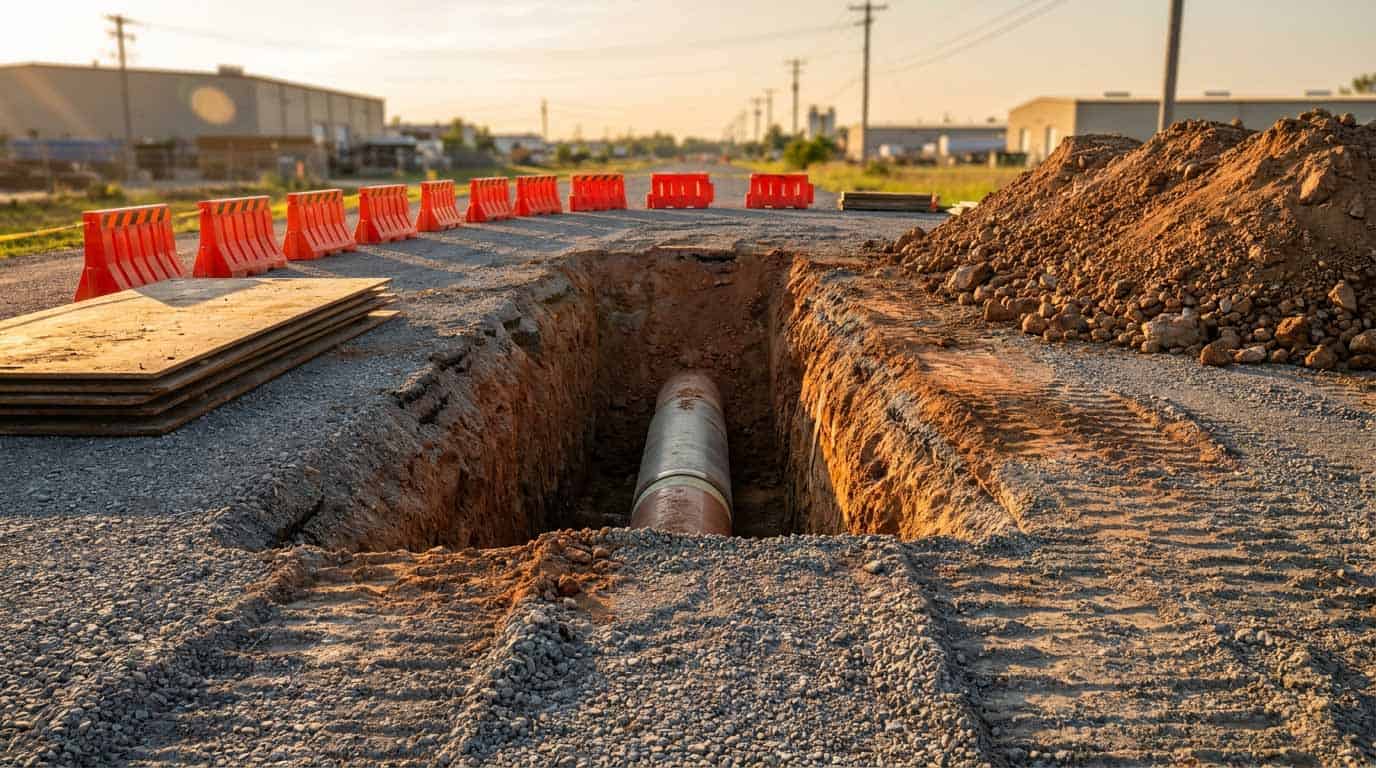
Trenchless or Open Cut: The Question Behind the Quote
Many comparisons between trenchless rehabilitation and open-cut excavation get run on price. Two bids arrive, one number is lower, and the lower number wins the argument before anyone asks what either number actually includes. That is the wrong question for a project engineer who has to defend the choice later. The right one is which method gets the line back into service with the least disruption to what the facility is actually there to do, which is produce something.
Hill Services fields this comparison often on refinery and petrochemical pipe lining work, where the two bids rarely start from the same assumptions. Horizontal directional drilling typically runs $10 to $50 per linear foot. Pipe bursting runs $30 to $80. Cured-in-place lining runs $50 to $250, a wide range because diameter, access, and liner chemistry all move the number. Open cut is often the cheaper figure on the page for a shallow run in unpaved ground: no pavement to cut, no traffic control, no permit for working under a road. That comparison is legitimate, though it applies less often on a working industrial site than the initial quote suggests.
Open cut is still the right call in specific situations. A line that has collapsed rather than cracked, a route that needs re-grading, or a diameter change partway down the run are cases where trenchless pipe rehabilitation does not fit the physical problem. A contractor willing to say the site should be excavated is worth more than one who quotes lining regardless of the job.
Days Against Weeks, Not Dollars Against Dollars
Timeline is where the two methods actually separate, not cost per foot. Cured-in-place lining typically runs 50 to 70 percent faster than open-cut replacement of the same line. Pipe bursting runs 30 to 60 percent faster. Horizontal directional drilling runs 20 to 50 percent faster. The range moves with ground conditions, depth, and access. The direction does not.
That gap compounds over the life of the asset, not just the life of the project. Trenchless methods are reported to deliver 30 to 50 percent lower total project cost than open-cut once maintenance and re-repair are counted alongside the installation invoice. A documented sewer rehabilitation case in Tanzania found cured-in-place lining delivered 48.2 percent total cost savings over open-cut across a 50-year asset lifespan, with the open-cut alternative running roughly 2.5 times higher annual maintenance cost over that period.
The physical footprint makes a similar point in a way that is easier to picture. A typical trenchless project displaces up to 95 percent less material than the equivalent open-cut job, and one documented comparison put it at 60 cubic meters of spoil against 1,200 cubic meters for a comparable run. That is the difference between a small crew working two access pits and a trench that follows the pipe for its entire length. Across the industrial service areas covered from Memphis and Houston, where working ground inside an active plant is often the scarcest thing on the property, that footprint difference is not a minor detail.
The Costs That Never Make the Quote
Neither bid counts what happens around the work, and that is where the real number lives.
Unplanned downtime inside an operating oil and gas or refining facility runs $500,000 or more per hour by industry benchmarks. Even a partial reduction in run time multiplies fast against a number that size. Facilities outside that tier still carry real exposure: heavy industry averages run closer to $187,500 an hour, and the all-sector average sits near $260,000 an hour, per Aberdeen Research.
The figure on the maintenance estimate is rarely the figure on the final invoice. Reported downtime costs typically run two to three times higher than the initial estimate once everything downstream of the schedule gets added in:
- Emergency parts and expedited materials, often at a 30 to 40 percent markup over standard lead time
- Idle labor across crews waiting on the line, not just the crew doing the repair
- Overtime recovery once the schedule slips and the facility buys back lost days
- Quality losses on any process that depended on the line running at spec
Access matters too. On a site where roads or throughways run over the pipe, trenchless methods can cut traffic and access disruption by up to 78 percent and reduce the associated business losses by roughly 70 percent compared to open cut. A haul road or fire lane blocked for the length of a trench is not a line item on either quote. It is a cost the rest of the plant absorbs while the pipe crew works.
Permits, Restoration, and the Rest of the Invoice
Open-cut work near roads, rail, or environmentally sensitive ground typically requires separate excavation, traffic, and environmental permits, each on its own review timeline outside the contractor’s control. Any one of them can hold up a schedule that otherwise looked fine on paper.
Surface restoration is its own line item that excavation carries and lining mostly avoids: repaving the road, re-landscaping the disturbed ground, and re-securing any foundation or slab the trench ran under. Those costs are easy to leave off an early estimate, since they land after the pipe work is technically finished.
The environmental profile adds up too. Trenchless projects have shown carbon emissions reductions ranging from roughly 59 percent in a Czech Republic study to more than 80 percent on a 25-mile Texas project, measured against comparable open-cut work. A lower emissions profile can shorten a permitting review, and it feeds directly into whatever ESG reporting a facility already produces.
The Record Behind the Ranges
The figures above are industry ranges. Hill Services has its own record against them.
A discharge line on the Houston Ship Channel, roughly 16,000 linear feet, was lined in place at approximately a third of the cost and time of conventional cured-in-place pipe, using a pressure-rated liner instead of the gravity method originally specified. A ten-inch water line running beneath cooling towers, buildings, and a main road at an operating plant, already failed more than once under patch repairs, was flushed, inspected, and relined in seven days without shutting the plant down. Neither job is a projection. Both are jobs that happened.
Frequently Asked Questions
Is Trenchless Always Cheaper Than Open Cut?
No. A shallow, unpaved run with no access, permitting, or restoration cost can still favor open cut on the initial number. The comparison changes once downtime, permits, and restoration get counted, which describes many working industrial sites.
What Makes a Line Unsuitable for Lining?
A collapsed section rather than a cracked one, a route needing re-grading, and a diameter change partway down the run are the common disqualifiers. The crew runs a camera on the line before recommending a method, because the pipe’s condition decides the method.
How Is Downtime Estimated Before the Work Starts?
By scoping the outage against the facility’s own production schedule, not an industry average, and accounting for the emergency-parts premium and idle labor.
Scoping the Decision Around Production, Not the Quote
The two numbers on the table at the start of this comparison are rarely the two numbers that decide it. Permits, restoration, access disruption, and downtime often run in the background of an estimate, and on an open-cut job they tend to run longer.
How Hill Services Approaches This
Hill Services scopes a line by what stops running while the work happens, not only by what the work itself costs. To weigh what a week of lining costs against weeks of lost production, permits, and restoration, request a project estimate or call Hill Services at (901) 388-7500.